
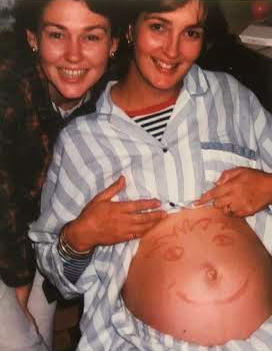
The smiling belly was the home to my daughter Belle.
Back then, in 1994, I honestly thought birth was just something you survived, collected a baby at the end of, and then got on with life while functioning on approximately three hours of sleep and cold cups of tea.
What I didn’t realise at the time is that something really important had been missing from my birth experiences.
It was years later, after studying midwifery and later diving into hypnotherapy and positive birth education, that I finally understood why I had felt strangely flat with the births of my children. I’d experienced a stillbirth at term, two caesareans, and an induced birth. But it wasn’t the type of birth itself that left the mark — it was the feeling of being unsupported, uninformed, and emotionally disconnected throughout the experience.
My birth preparation was negligible. There were no antenatal classes where we lived, no Instagram birth educators, and no online village of mums sharing wisdom at 2 am. The only pregnancy book I remember reading was Up the Duff by Kaz Cooke — which, to be fair, probably kept me sane with humour alone.
I was the first of my friends to have a baby, so there wasn’t really anyone to swap stories with or ask the big questions like:
“Is this normal?”
“Why am I terrified?”
“Why does everyone suddenly want to tell me their horror birth story in the supermarket?”
My husband, like many good Kiwi and Aussie blokes of that era, saw pregnancy and birth as “women’s business.” We were living in Australia, away from family, without a support network and village that so many women quietly rely on.
After a stillbirth, we chose obstetric care for the next pregnancy because we believed it would feel safer. And medically, we were well cared for. But emotionally? It felt clinical and disconnected. I often felt more like a patient on a production line than a woman becoming a mother.
There was no real sense of teamwork, no guidance for the massive emotional transition into parenthood, and no one talking about how birth changes both people in the parenthood relationship. Looking back now, I understand why I felt deep emptiness.
That journey - and everything I subsequently learned through midwifery, hypnobirthing, and acupressure for labour - became the foundation for Birthtrix.
I believe couples deserve more than just “getting through” birth.
They deserve proper preparation.
They deserve evidence-based information without the fear-mongering.
They deserve support, connection, confidence, and choices.
And they deserve to feel like active participants in one of the biggest transitions of their lives - regardless of how their baby arrives.
My goal is to share what I’ve learned both professionally and personally, so couples can head into labour feeling informed, capable, connected, and maybe even excited about the experience ahead.
A positive birth experience doesn’t just impact the day your baby is born - it can shape confidence, relationships, parenting, and family life for years to come.
And that, right there, is the heart of Birthtrix.